
What Is Mehregan? The Persian Festival of Love and Light
There were thirteen of us kids in my family. We never had more than three bedrooms. I was the last, which means I grew up in a house where a holiday was never a small thing and a table was never set for four.
One of the things that Westerners do not understand about Iran is that we are not natively Islamic, a religion that was forced upon us. Culturally, we are Zoroastrians. (You can look it up, but if you saw Freddy Mercury with this family in the movie Bohemian Rhapsody, you get it.) And even the Islamic families in Iran celebrate the Zoroastrian traditions.
Mehregan was one of those days. The Persian festival of friendship, love and light, named after Mehr: both an ordinary word and an old one.
In Farsi, mehr means love, kindness, affection. Mehr is also the ancient Persian figure Mithra, who watched over friendship and over the promises people made to one another. Mehregan means the celebration of Mehr. That is the whole of it. A day for love.
If you know Nowruz, you already have the shape of it. Nowruz marks the start of the Persian New Year and the beginning of spring. Mehregan is its autumn counterpart, six months around the year.
Nowruz is the beginning. Mehregan is the gathering.
When Mehregan falls
Mehregan is celebrated in the Iranian month of Mehr, which arrives with the autumn and marks genuine gratitude for what the past year produced. UNESCO added Mehregan to its list of the world's intangible cultural heritage in 2024 and describes it as tied to the harvest. And while accurate, that was just never the headline in my house. The headline was who was coming to celebrate.
What happens on a Mehregan table
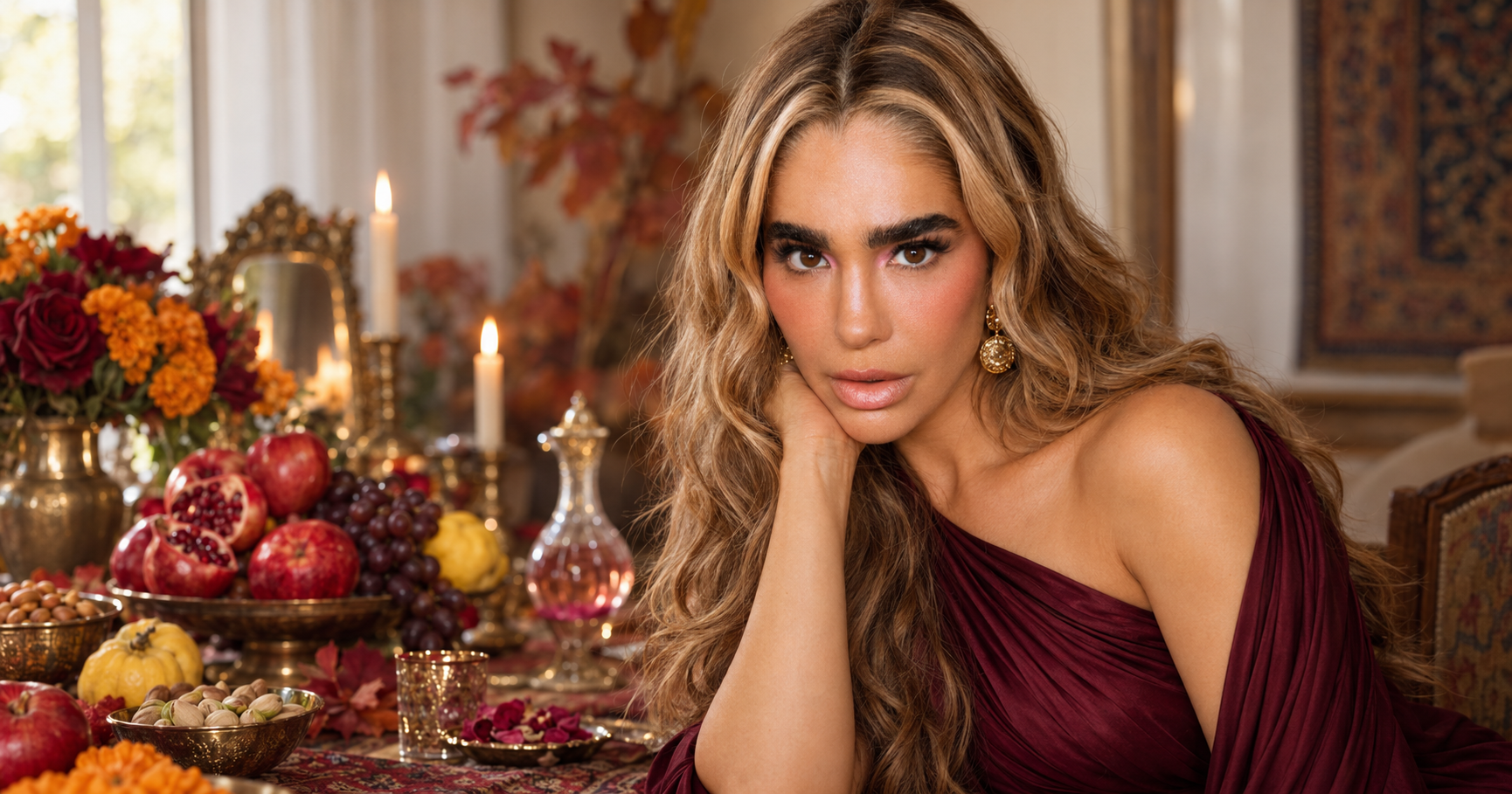
A sofreh -- literally translates to "spread" or "tablecloth" -- for Mehregan is laid out and is then covered with snacks. Pomegranates, apples, grapes. Ajil, which is the mix of nuts and dried fruit that appears on every Persian table worth sitting at. Dried marjoram. And rosewater (of which I typically have two bottles in my refrigerator at any time)
A mirror. A candle. Incense, usually esfand,. Silver coins. A sormeh-dan, the little container of kohl (an ancient black eye liner for the gals). Sometimes a copy of the Avesta -- the most ancient scriptures of Zoroastrianism -- depending on the family.
Every item is doing a job. The coins are for the year ahead. The kohl goes around the eyes for protection. The marjoram and the seeds get thrown over each other's heads (which sounds dignified written down, but not when it is happening to you).
The mirror is the one I think about most. You stand in front of it to say prayers -- and what you are looking at is your own face with everyone you love standing behind it. I did not understand that as a child. I understood it later.
And the pomegranate is always on the table. It turns up at Mehregan and again at Yalda in December -- the bookends of the Persian autumn, red and full and impossible to open neatly.
What people actually do
For Mehregan, we wear something purple or violet, or simply something new. The old custom was that the king put away his summer clothes and moved into autumn ones -- and somewhere along the line that became the rest of us buying a sweater.
We drink sharbat -- made from fruit, flower extracts and herbs -- or pomegranate juice, but the point is to drink it with somebody.
Give a gift. Give something away to someone who needs it, which is part of the day and not an add-on to it. Throw the seeds. Say the words:
Mehregan mobarak.
مهرگان مبارک.
Happy Mehregan.
The part that is harder to explain
We left Iran, but Persia still defines my family.
I have set a Mehregan table in countries where nobody outside our front door knew what day it was. No shops selling the right things. No neighbors saying the words back. Just us, doing it anyway -- because the alternative was to let it go quiet, and once a thing goes quiet in a family it usually dies.
A festival is not a place. It does not need the country it came from in order to happen. It needs a table, someone willing to set it, and people who show up. That is the entire requirement. Everything else is decoration.
The mirror still works in a rented apartment. The pomegranate tastes the same. The words are the words.
So we kept the traditions: and the traditions kept us. And the fact that I can write this down now under my own name, in my own voice, in a country I chose, is not a small thing to me. I am aware every year of how much had to go right for a girl from that crowded, cramped home to be sitting here typing this.
If you have never celebrated it
You are welcome to celebrate with us. That is not me being polite, but rather the essence of the day. Mehregan is about friendship and it does not check anybody's paperwork at the door.
Buy a pomegranate. Light a candle.
Call the person who has been in your corner all year and has not heard from you in a month. Tell them out loud what they mean to you -- which is sometimes harder than it sounds but is the only part that really matters.
That is Mehregan. Everything else on the table is there to remind you to do that.
The Squad hears from me first when something new is coming, and that is simply the order things happen in around here. If you would like to be on that side of it, come join us.
Mehregan mobarak. May your autumn be full of the people who make you feel like you.
XOXO SHAB